Showing posts with label california tidbit. Show all posts

Friday, October 12, 2012

Hanging with the Avocados & the Boys


This last week, on 5 OCT 2012, the boys and I had an opportunity to go to the California Avocado Festival held in Carpinteria, just south of Santa Barbara.

I have to admit the festival wasn't as big as the Strawberry festival I go to in May, but it was fun. What I liked the most about the festival was that it was totally low-key and I love low-key.

The festival started in 1987. Yikes! I'd been the Army for a year when it started! There were several booths selling the green gem. For me, it's about the guacamole. The boys and I got a dish of chips and guac, and I just loved how fresh it was.

Andrew and his guac

Lunch for me was carne asada tacos w/gauc. Andrew had fish and chips and gauc. Joe had chicken fingers and French fries. There was a jumper for the boys and I got Andrew a poster for his room.

The festival is big into recycling. Brent and I heard a group called "Sean Wiggins and Lone Goat," and we really enjoy them. Their music reminded me of a young Melissa Etheridge. We got two of their CD's "The Kitchen Sink" and "Naked Thursday." I loved their cover of Johnny's Cash's "Folsom Prison" song.

Hope to see you next year at the festival. Hehe

We made it!

Hanging out with Joe and the Avocados!

Joe looking for the avocados!

Bio: Stephanie Burkhart was born and raised in Manchester, NH. She joined the U.S. Army in 1986 and spent 7 years stationed in Germany. In 1997, she left the service and settled in California with her husband. Currently she works for LAPD as a 911 Dispatcher. She loves exploring her new state with her boys.

Thursday, August 2, 2012

California Thursday - Exploring the Golden Gate Bridge


Set against the bay area of San Francisco, the Golden Gate Bridge has been declared one of the modern wonders of the world by the American Society of Civil Engineers.

The Bridge itself spans the bay between San Francisco and Marin County. Ferry service began as early as the 1820's and grew to a daily occurrence. In San Francisco, you'd catch the ferry at the Hyde St. Pier and it took you to Sausalito in Marin County. The journey took 20 minutes and cost $1.00 per vehicle. (Those were the days, huh?)


In 1916, a call was put out to entertain practical designs for the bridge. Joseph Strauss, an engineer, jumped on board and his designs were given serious consideration.

Joseph Strauss didn't do it alone – several engineers and designers offered their input, including Leon Moisseiff, Irving Morrow and Charles Ellis. Strauss was the chief engineer in charge of the overall design and construction.


Show Me The Money

In 1928, the Golden Gate Highway District was given authority to finance the bridge.

In 1929 Wall Street crashed. The district couldn't raise the funds it needed so it asked for $30 million in bonds and got it. The budget for the bridge at the time was $27 million.

So bought $30 million dollars worth of bonds? Amadeo Giannini founder of the Bank of America (in San Francisco) bought the ENTIRE issue in 1932 to help the local economy. (Bank of America – go figure! Nowadays I wonder.)


Time to Crack The Nut

The construction started in January 1933. The Golden Gate Bridge can truly say it was made in America. The steel came from New Jersey, Maryland, and Pennsylvania and was shipped to California via the Panama Canal.

NOTE: In April 2012, Jack Balestreri died. He was the last living original construction work on the bridge.


Half Way to Hell Club

A net was placed under the bridge during construction – for safety reasons, of course. With a 245 foot drop from the deck of the bridge to the water, 19 men were saved by landing in the net, thus becoming members of the Half Way to Hell club.

The bridge opened in May 1937. The span is 4,200 feet. It's #9 in the world today. It's painted "international" orange.


More Money Issues

The last of the construction bonds was paid off in 1971. The actual principal paid on the bond was 35 million. The interest? 39 million. The interest was paid with the tolls collected from the bridge.

Don't Jump

The deck of the bridge is 245 feet over the water if you jump. It takes 4 seconds to reach the water. Your speed? 75 mph/120 kph. Jumpers die from impact trauma on contact with the water. The few that survive will drown or die of hypothermia. Only 26 people have survived a jump.


It's Windy

The bridge shut down due to wind speeds between 69-75 mph on 3 occasions: Once in 1951, 1982 and 1983.

We're Not Finished with the Money Issues

The bridge is undergoing a seismic retrofit which is due to be completed this year. It's needed because of a possible failure of the support on the 320 foot arch over Ft. Point should an earthquake strike. The cost? $392 million.

Interesting Fast Facts:

The closest off the shelf paint to the gate's color is available from Sherwin Williams. It's Fireweed.

The Golden Gate Strait is the entrance to San Francisco Bay from the Pacific Ocean.

It's illegal to scatter the ashes of a loved one from the bridge.

Famous Bridge Movies:
2011 Rise of the Planet of the Apes
2009 Star Trek
2006 X-Men, The Last Stand.
1994 Interview with the Vampire
1978 Superman
1941 The Maltese Falcon.

References:
http://goldengatebridge.org/research/facts.php
http://en.wikipedia.org/wiki/Golden_Gate_Bridge

Photos taken from:
http://commons.wikimedia.org/wiki/Golden_Gate_Bridge


Stephanie's Latest story is Journey of the Heart: a sweet vintage romance set in Sonoma, CA, near San Francisco.

JOURNEY OF THE HEART


Blurb: Can James help Rachel save her winery or will he drift out of her life the same way he drifted in?

4, 5 Star Reviews on Amazon
The story was compelling and not boring, which is often a stereotype of sweet romances. I would recommend this short sweetie of a story. Good job, author. - Angel E

Excerpt: 
"Your case threatened to run away, so I bribed it." Her sweet expression was an arrow through his heart. 

"Really? What did you bribe it with?" He wiped the sweat off his brow with a handkerchief, caused from a combination of the summer heat and lifting the heavy cases. 

"A job."

He hooked his thumb toward his chest. "Are you offering me a job, Miss Santori?"

BUY LINK: http://amzn.com/B008G1JI6C

Thursday, June 28, 2012

California Thursday - Ansel Adams


Growing up in New Hampshire, I had no idea who Ansel Adams was, but I loved his photography. My favorite is "Monolith, the face of Half-Dome" and a winter picture, "Half Dome Apple Orchard." What I love about his photography was how detailed the picture was using black and white tones. The detail made me pause, whistle, and say "that's really cool." For me, "Monolith," is simply majestic, and "Apple Orchard" captures the beauty that I find in winter.

Now I knew a majority of his photography was taken in Yosemite, but silly me, I didn't realize he was a native Californian until this year when my son, Andrew, picked Ansel Adams as his wax museum project for school.

Andrew and I learned a lot together and now we both share a love of Adams' photography. His favorite is: "Mt. Williamson."

Ansel was born in San Francisco in 1902. Hyperactive, he was also a sickly kid. He had no patience for sports, but he loved being in nature. When he was 12, he taught himself piano and began grooming himself to become a professional piano player until his dad took him to Yosemite for the 1st time in 1916. His father also gave him a Kodak Brownie camera on the trip and Adams' love of photography was born.

In 1917, Adams joined the Sierra Club were he nurtured his sense of respect for nature. The Club's goal is to preserve nature's wonders. Adams fit right in and over the years was very active in the club.

He picked up photography and dark room techniques quickly. His 1st photos were published in 1921.

Adams did it all – he experimented with soft focus and etching, but he preferred a more realistic approach to his photography relying more on sharp focus, heightened contract, and precise exposure as well as expertise in the dark room.

In 1927, he took "Monolith" (my favorite). He also published his 1st portfolio: Parmelian Prints of the High Sierras.

In the 1930's, Adams expanded on his work, focusing on detailed close-ups and large forms. In 1931, the Smithsonian hosted his 1st solo museum exhibition. Most of the photos used in the show came from the high sierras.

In the 1940's during World War II, he went on several photographic assignments for the government. One included traveling to the Aleutians and taking pictures of secret Japanese installations.

In 1963, he released his 4th (and last) portfolio – What Majestic Word. The 1960's also saw major art galleries begin to exhibit his work.

In the 1970's Adams worked to reprint negatives from his vault to satisfy demand for his work. He did experiment with color, taking portraits mainly of landscapes and architecture. Adams didn't like color. He couldn't control the balance as well as a black and white photo and he found color distracting, but he does have some color prints.

Did you know? His photography "The Tetons and The Snake River" is one of 115 images on the Voyager spacecraft?

QUESTION AND GIVEAWAY: Adams took the first official portrait of a president. Who was the president?

Answer the question and leave your email. I'll pick a winner out of the right responses to receive a copy of my upcoming vintage release, "Journey of the Heart," set in 1946 Sonoma California.


Thursday, January 19, 2012

California Lighthouse Series - Point Sur, CA


California's Central Coast is one of the longest and remotest areas of the coastline. Let me paint you a picture – we all know where LA is, now go approximately 100 miles north and you find Santa Barbara. Approximately a 2 hour drive north from Santa Barbara is San Luis Obispo and San Simeon, where the Hearst Castle resides. Continue north and the coast turns rugged and remote. The next major city you'll come up to is Carmel and Monterey – an approximate journey of 3 hours. Point Sur is in this rugged patch of land, closer to Carmel and Monterey. While there were lighthouses near San Luis Obispo and Carmel, it was soon determined one was needed at Point Sur.

The big shipwreck that spurred action was the Ventura in 1875. It should be noted that while not having a light on Point Sur contributed to the wreck, it didn't help the Captain was drunker than a skunk.

Congress soon allocated the money for Point Sur to be built. The facility was constructed on a 361 ft. tall rock. Between the rock and mainland is a "tombolo," lowland that is covered with water from time to time cutting off the rock from the coastline.

The light at Point Sur was lit on 1 August 1889. According to my research, it first used an oil wick lamp with whale and lard oil then kerosene used as the fuel. Finally, a 1st order Fresnel lens was brought in. The lens was practically 9 feet tall itself. The visibility of the lens was 23 nautical miles.


To help out during dense fog, a foghorn was installed – run by coal generated steam.

Point Sur is known as a light station – not a lighthouse. Why? Because it was so remote, it basically had to provide for itself since there was no road until 1937.

There was 1 head keeper and 3 assistant keepers. A cistern held the water, a barn held the cattle and horses, and blacksmith shop provided metal supplies. The kids didn't go to school daily. In 1927 a school teacher was assigned. They were usually young women straight out of college. Unfortunately, they didn't last long since the area was so remote and lonely.

How did the station get their supplies? Animal feed, coal, and firewood arrived on long, broad ships known as a "lighthouse tender." It would anchor near the station and the supplies put on skiffs and towed to land. That's a hard life if you ask me.


Finally in 1937, Highway 1 connected Point Sur to the rest of the world. Known in California as the Pacific Coast Highway, it runs as close as it can to the California coast from San Diego to the northernmost border. Once that happened, the US Coast Guard took over the lighthouse station in 1939.

Ships still wrecked though in 1894, 1909, 1915, 1921, 1930, etc. The most notable wreck wasn't a ship, though – it was a dirigible.

On 12 Feb 1935, the USS Macon, a dirigible crashed at Point Sur. The lighthouse keeper related that the fin went to pieces and the nose dived into the water. Out of the 83 crewmembers only 2 survived. The Macon was powered by helium. (much safer than hydrogen and that's not saying a lot) The skin was cotton, the frame, aluminum and the airship was 3 times as long as a Boeing 747. Top Speed? 80 mph. The Macon also carried 4 reconnaissance airplanes.


In 1974 the last Coast Guard keeper left the station. The light is now fully automated with an aero beacon used for light and airhorn instead of a coal-driven steam powered foghorn. The 1st order Frensel lens is on display at the Monterey Maritime museum. You can find a display of the Macon at the Point Sur light station visitor center. The station is one of the complete and preserved in California.


FIND ME ON THE WEB AT:
WEBSITE:
http://www.stephanieburkhart.com

TWITTER:
http://twitter.com/StephBurkhart

FACEBOOK:
https://www.facebook.com/pages/Stephanie-Burkhart-Author/149938795021166

GOOD READS:
http://www.goodreads.com/author/show/4031660.Stephanie_Burkhart

Friday, January 14, 2011

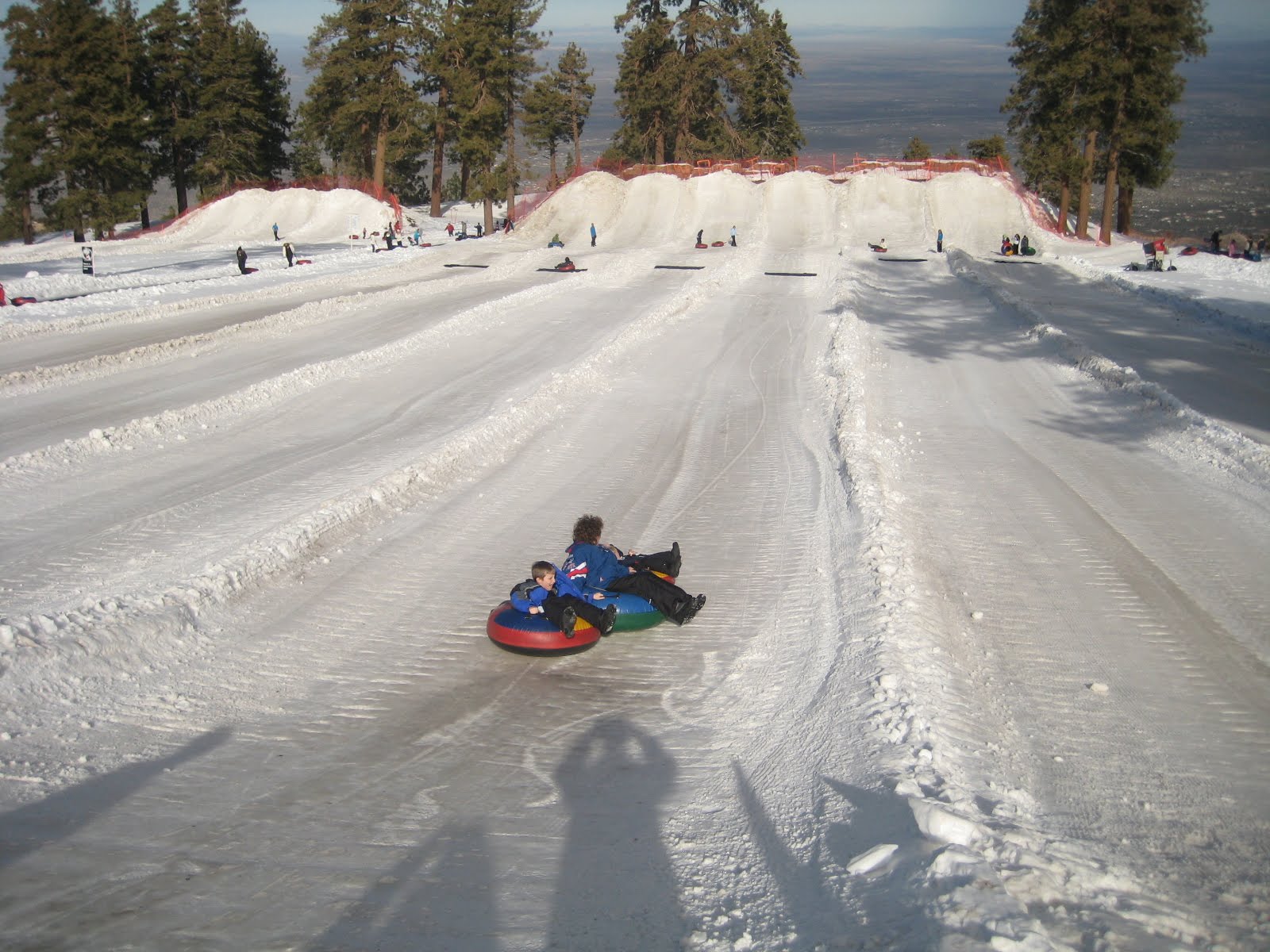
There's Snow in Southern California

Me, Andrew and Joe getting ready to go down the slope!

There's snow in Southern California. No, really, there is. You just have to know where to look.

My son's cub scout troop sent out an email saying they were going snow tubing in Wrightwood. I raised an eyebrow. Being a non-native I was skeptical. Where was Wrightwood?

My husband knew all about it. He went to Dick's Sporting Goods and had a field day buying us boots, bibs, hats, and gloves. I went to Google maps.

Then again, I should have known better. Southern California does get snow. It snowed at my house on New Year's Day in Castaic. Andrew & Joe had a blast making snowballs. It was the first time in my 13 years living in SoCal I saw snow falling in my back yard, but I digress.

Wrightwood, CA is in the Angles National Forest which is just northeast of LA. It's a very high elevation – 6,000 foot, hence the snow. And it's only 1 ½ hours from my house. 13 years and I totally missed it. Someone buy me clue.

We looked like New England snow bunnies after my husband was done at Dick's, but we were ready for the snow. Thankfully, we didn't need chains going up the hill. (Hubby bought them, too!)

We're off!


We arrived at the Mountain High Resort around 9:30 am. After a long wait it was time to tube! (Because, let's face it, it's not easy organizing a troop event with all the kids and parents and you know some people – they are professionally late.)

Snow tubing is fun. You ride an inner tube down a long slope. My 4 year old, Joe, had a blast. He could have tubed all day non-stop, but Mom had to hold his tube and I got pooped! Andrew went down the slopes with his cub scout buddies.

Rumor was Adam Sandler was on the slope. I didn't see him. Adam and I went to the same high school, but he was 2 grades ahead of me. We had the same "evil" assistant principal – Mrs. Pellerin. You know that "evil" look, the one that makes you run down the hall the other away? Again, I digress.

I didn't see Adam Sandler, but a lot of people were checking out my really cool New England Patriots Starter jacket.

The Hubby


We tubed for two hours and on the way home we stopped by the Grizzly Café in Wrightwood for lunch. The food was tasty and there was a lot ambience (something that's missing in the restaurants around where I live.)

Hubby is planning another trip this coming Sunday. I think it's going to be a blast, but I'm going to keep an eye out for Mrs. Pellerin. You never know…

Thursday, August 19, 2010

California Thursday - Poppies


I must admit to neglecting the blog this month, but I've been on a blog tour for "The Giving Meadow," and I've been working hard on 3 projects - 2 short stories and a novel length project, but I thought I'd pop in here and gush about the California Poppy.

Did you know it's the state flower of California? Not being a native, it's been a challege to learn about my adopted state. Maybe I'll focus on some of the basics. California is certainly a pretty state. It's a big state. New England could fit in the state at least 3 times overs. For me, personally, it's a little disconcerting to drive 6 hours and still be in the same state after growing up in New England. And I live in the desert. I kinda miss the snow, but I digress.

I find that poppies first come out in March and April in California. They are red, orange, yellow and occassionally pink. The petals close at night and open in the morning. April 6th is California Poppy Day in CA. A week long poppy festival is usually held in Lancaster, CA in April. Here's a link:http://www.poppyfestival.com/


They also have health benfits:


Sleep disturbances. Helpful for a gentle restful sleep.
Toothache. Reduces inflammation causing pain.
Anxiety. Although related to opium poppy, does not have addictive properties, gentle anti-anxiety effect.
Restless leg syndrome. Stops muscle spasms and relieves pain.


Interesting, huh, how herbal cures work. Some cautions though:
Use caution while driving or operating machines and taking calendula and sedative medications.
Do not take orally if pregnant, as it may cause uterine contractions.

I hope you find this interesting. I sure did!

Thursday, February 25, 2010

California Tidbit Thursday - Lake Tahoe


Here's another California place I've never been, but would like to go to - Lake Tahoe. The opening shot is Lake Tahoe from Space. Pretty, cool, huh? Now just imagine a line right down the middle. To the east is Nevada, to the west is California. The big California cities near the lake are: Tahoe City and King's Beach, both are on the northern side.

Lake Tahoe is a freshwater lake. It is 1,645 feet deep, making it America's second-deepest freshwater lake, (Crater Lake, in Oregon, being the deepest at 1,945 feet deep.

The lake was formed about 2 million years ago and is a part of the Lake Tahoe Basin with the modern lake being shaped during the Ice Ages. It is known for the clarity of its water and the panorama of surrounding mountains on all sides. On the Nevada side of the lake you'll find plenty of Casinos. Tahoe is known for winter sports including Skiing and snowboarding.


THE COMSTOCK LODE

The Comstock Lode, a silver deposit just 15 miles (24 km) to the east in Virginia City, Nevada was discovered in 1858. From 1858 until about 1890, logging in the basin supplied large timbers to shore up the underground workings of the Comstock mines. The logging was so extensive that loggers cut down almost all of the native forest. In 1864, Tahoe City was founded as a resort community for Virginia City, the first recognition of the basin’s potential as a destination resort area.

No wonder why Nevada is the Silver State.

MANSIONS ON THE LAKE:

Lake Tahoe is also the location of several 19th and 20th century homes of historical significance. Vikingsholm was the original settlement on Emerald Bay and included an island teahouse and a 38 room home.


The foundation was laid in 1928, but the building was constructed in 1929 by 200 workers. Vikingsholm was built by Mrs. Lora Josephine Knight as a summer home. Some parts of the structure contain no nails or spikes, as a result of old-fashioned construction methods. Most of the building was made from materials found at Lake Tahoe.

Mrs. Knight is primarily known for building Vikingsholm, but she and her husband were primary backers of Charles Lindbergh's non-stop solo flight across the Atlantic in 1927. Tours are given of the home for a nominal fee.

Vikingsholm, along with the "Tea House" on Fannette Island and Emerald Bay, is a part of Emerald Bay State Park. Emerald Bay has also been declared a National Natural Landmark.

INTERESTING NOTE: Squaw Valley, near Tahoe City, was the site of the 1960 Winter Olympics.

Heck, I wouldn't mind going to check out this gem - in the summertime. hehe
Smiles
Steph


Info for this article was taken from:
http://en.wikipedia.org/wiki/Lake_Tahoe
http://en.wikipedia.org/wiki/Vikingsholm

Thursday, January 14, 2010

A California Tidbit - San Diego, CA

SAN DIEGO AT NIGHT

I’ve been to San Diego on several occasions since moving to California in 1997 and it’s a great city. I’ve seen the Padres play the Dodgers down in Petco Stadium, I’ve been to the NFL experience hosted at Qualicom one year. I’ve also been to the Zoo and Sea World. There’s so much to see and do there, you need two or three quality days to just hang out.

San Diego is the 2nd largest city in California and the 9th largest in the US. It’s population is over 1.2 million.

San Diego is the southern end of the El Camino Real, a trail the monks took which established missions along with the way. The mission in San Diego is called Mission San Diego de Alcalá. It was founded by Junipero Sierra in 1769. In 1976, Pope Paul VI had it declared a minor basilica. Over the centuries it’s seen its fair share of war. In 1860’s when it was returned to the Catholic Church, it was in ruins. Today it’s a landmark and a thriving parish.

THE MISSION IN SAN DIEGO


San Diego has a rich military history. San Diego is the site of one of the largest naval fleets in the world, and San Diego has become the largest concentration of Naval facilities in the world due to base reductions at Norfolk, Virginia and retrenchment of the Russian naval base in Vladivostok. Two of the U.S. Navy's Nimitz class supercarriers, (the USS Nimitz and the USS Ronald Reagan), five amphibious assault ships, several Los Angeles-class "fast attack" submarines, the Hospital Ship USNS Mercy, carrier and submarine tenders, destroyers, cruisers, frigates, and many smaller ships are home-ported there. Four Navy vessels have been named USS San Diego in honor of the city.

Currently, the USS Midway, a decommissioned air craft carrier that was last “in service” during the 1st Gulf War is down in San Diego. My husband and I are planning a trip down there in April to see it.

One of San Diego’s premium attractions is Sea World, home of Shamu the killer whale. There are plenty of ocean life exhibits in Sea World. Of course my favorite is Shamu, but I also like visiting the dolphins and penguins. They also have a Budweiser exhibit as well. Another attraction is the zoo. Some of China’s famous pandas stay at the San Diego zoo.

SHAMU AT SEA WORLD


The downtown area has captured an old town feel with it’s use of gas lamps and it’s often called the Gas lamp district. San Diego is less than 20 minutes away from Mexico and Tijuana.

If you’ve gone to San Diego, I’d love to hear about your trip and what you enjoyed about the city. For me, San Diego is an hidden jewel on the California coast.

References for this blog entry:
http://en.wikipedia.org/wiki/San_Diego
http://en.wikipedia.org/wiki/SeaWorld_San_Diego
http://en.wikipedia.org/wiki/Mission_San_Diego_de_Alcal%C3%A1