Showing posts with label California lighthouse series. Show all posts

Thursday, June 21, 2012

CA Lighthouse Series - Battery Point, CA


I love exploring California's lighthouses – even if I haven't had a chance to visit one yet. ☺. I've discovered that a majority of lighthouses are in the San Francisco area, so for this adventure, I opted to visit Battery Point, in Crescent City, CA.

Crescent City is just a couple of miles south of the Oregon border. Sound familiar? When the recent 2011 Japanese Tsunami hit, Crescent City was struck with higher than normal waves that ripped out docks and swept a photographer out to sea.

For me, the most interesting part about a lighthouse is the history and Battery Point has several stories in it's past. In 1855, the ship, America, burned in the Crescent City harbor. 3 cannons were recovered and mounted on the northern entrance. The cannons were used in Crescent City's 4th of July celebration, earning the name Battery Point.

In May 1855, Congress set aside 15,000 dollars for the construction of the Battery Point lighthouse. It was built on a tiny islet connected to Battery Point by an isthmus at low tide. Due to the location, the lighthouse can only be accessed at low tide.


The lighthouse opened with a 4th order Fresnel Lens. (A Fresnel lens allows the construction of lenses of large aperture and short focal length without the mass and volume of material that would be required by a lens of conventional design. Compared to conventional bulky lenses, the Fresnel lens is much thinner, larger, and flatter, and captures more oblique light from a light source, thus allowing lighthouses to be visible over much greater distances.)

The first lighthouse keeper was Theophilis Magruder. His starting pay was $1,000, but when he received a 40% pay cut he resigned. (Author's Note: I'd quit too if I had a 40% pay cut!)

In 1953, the lighthouse became automated. The Del Norte Historical Society became involved and now the lighthouse is a museum. The lighthouse is also listed as a private aid to navigation and is still in use.

In March 1964, a 9.2 magnitude earthquake struck in Alaska, triggering a tsunami. Waves raced southward, hitting up to 20 feet in Crescent City. Incredibly, the lighthouse received no damaged, but Crescent City suffered the most damage on the Pacific Coast.

Watch where you step! The lighthouse has a ghost that haunts the halls.

Interesting side note: Battery Point is the setting for 2 novels: "Walk Across the Sea," by Susan Fletcher, a historical YA fiction, and "The Lightkeeper's Daughter," by Colleen Coble, a 2010 inspirational romance.


Question: Have you visited a lighthouse? What did you like about it? Any stories you'd like to share?


References for this blog:

http://en.wikipedia.org/wiki/Fresnel_lens
http://www.lighthousefriends.com/light.asp?ID=58
http://en.wikipedia.org/wiki/Battery_Point_Light

Thursday, January 19, 2012

California Lighthouse Series - Point Sur, CA


California's Central Coast is one of the longest and remotest areas of the coastline. Let me paint you a picture – we all know where LA is, now go approximately 100 miles north and you find Santa Barbara. Approximately a 2 hour drive north from Santa Barbara is San Luis Obispo and San Simeon, where the Hearst Castle resides. Continue north and the coast turns rugged and remote. The next major city you'll come up to is Carmel and Monterey – an approximate journey of 3 hours. Point Sur is in this rugged patch of land, closer to Carmel and Monterey. While there were lighthouses near San Luis Obispo and Carmel, it was soon determined one was needed at Point Sur.

The big shipwreck that spurred action was the Ventura in 1875. It should be noted that while not having a light on Point Sur contributed to the wreck, it didn't help the Captain was drunker than a skunk.

Congress soon allocated the money for Point Sur to be built. The facility was constructed on a 361 ft. tall rock. Between the rock and mainland is a "tombolo," lowland that is covered with water from time to time cutting off the rock from the coastline.

The light at Point Sur was lit on 1 August 1889. According to my research, it first used an oil wick lamp with whale and lard oil then kerosene used as the fuel. Finally, a 1st order Fresnel lens was brought in. The lens was practically 9 feet tall itself. The visibility of the lens was 23 nautical miles.


To help out during dense fog, a foghorn was installed – run by coal generated steam.

Point Sur is known as a light station – not a lighthouse. Why? Because it was so remote, it basically had to provide for itself since there was no road until 1937.

There was 1 head keeper and 3 assistant keepers. A cistern held the water, a barn held the cattle and horses, and blacksmith shop provided metal supplies. The kids didn't go to school daily. In 1927 a school teacher was assigned. They were usually young women straight out of college. Unfortunately, they didn't last long since the area was so remote and lonely.

How did the station get their supplies? Animal feed, coal, and firewood arrived on long, broad ships known as a "lighthouse tender." It would anchor near the station and the supplies put on skiffs and towed to land. That's a hard life if you ask me.


Finally in 1937, Highway 1 connected Point Sur to the rest of the world. Known in California as the Pacific Coast Highway, it runs as close as it can to the California coast from San Diego to the northernmost border. Once that happened, the US Coast Guard took over the lighthouse station in 1939.

Ships still wrecked though in 1894, 1909, 1915, 1921, 1930, etc. The most notable wreck wasn't a ship, though – it was a dirigible.

On 12 Feb 1935, the USS Macon, a dirigible crashed at Point Sur. The lighthouse keeper related that the fin went to pieces and the nose dived into the water. Out of the 83 crewmembers only 2 survived. The Macon was powered by helium. (much safer than hydrogen and that's not saying a lot) The skin was cotton, the frame, aluminum and the airship was 3 times as long as a Boeing 747. Top Speed? 80 mph. The Macon also carried 4 reconnaissance airplanes.


In 1974 the last Coast Guard keeper left the station. The light is now fully automated with an aero beacon used for light and airhorn instead of a coal-driven steam powered foghorn. The 1st order Frensel lens is on display at the Monterey Maritime museum. You can find a display of the Macon at the Point Sur light station visitor center. The station is one of the complete and preserved in California.


FIND ME ON THE WEB AT:
WEBSITE:
http://www.stephanieburkhart.com

TWITTER:
http://twitter.com/StephBurkhart

FACEBOOK:
https://www.facebook.com/pages/Stephanie-Burkhart-Author/149938795021166

GOOD READS:
http://www.goodreads.com/author/show/4031660.Stephanie_Burkhart

Thursday, September 29, 2011

California Lighthouse Series - Pigeon Point, CA


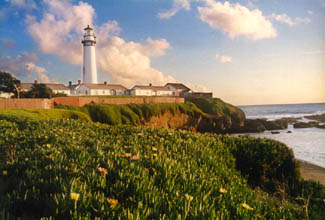
A couple of weeks ago I shared with you one of the ugliest lighthouses in California at Long Beach. Today, I make up for it by sharing one of the most picturesque lighthouses – Pigeon Point.

Pigeon Point is located south of San Francisco on a rocky promontory. (mass of rocks) Its 115 feet tower makes it one of the tallest lighthouses on California's coast.

Pigeon Point opened in SEP 1871 with a steam whistle (fog signal). Unfortunately, bad weather and heavy rain caused a 14 month delay with installing the light. On 15 NOV 1872, the 1st order Frensel lens went into use. A frensel lens was developed by French physicist Augustin-Jean Fresnel for lighthouses. The design allows the construction of lenses of large aperture and short focal length without the mass and volume of material that would be required by a lens of conventional design. Compared to conventional bulky lenses, the Fresnel lens is much thinner, larger, and flatter, and captures more oblique light from a light source, thus allowing lighthouses to be visible over much greater distances. (Definition taken from Wikipedia: http://en.wikipedia.org/wiki/Fresnel_lens)

Pigeon Point's Frensel lens weighed 4 tons and rotated every 4 seconds. Originally powered by a clockworks and weight, electricity replaced that in 1926.


A lighthouse is only as interesting as the people and stories behind it and Pigeon Point has some interesting stories. The one I found most interesting involved The Carrier Pigeon, a 175 ft. Clipper ship.

That's a Bummer

In the fall of 1852, a Clipper ship, The Carrier Pigeon, began its maiden voyage from Bath, Maine. After traveling around Cape Horn, it traveled up the west coast of the Americas. Not far away from San Francisco, near Santa Cruz, the fog really got thick and the boat struck rocks, sinking. The crew made it to shore, but the ship was lost. Sadly, the boat was valued at $54,000. In the 1860's, 3 more ships were lost in this area due to the heavy fog.


Can you imagine traveling months down the east coast of the Americas, through Cape Horn and up the west side of the America only to crash miles from your destination? Big Bummer.

Today the tours to the tower are closed due to crumbling brickwork, but every year on the 15th of NOV the Frensel lens is lit to celebrate its anniversary. The lighthouse keepers housing currently serves as a youth hostel.

Thursday, August 25, 2011

California Lighthouse Series - Lime Point, Marin County, CA


Lime Point, believe it or not, is under the Golden Gate Bridge. A rocky spur located on the northern side of the Golden Gate Bridge roughly extends 100 feet into the bay and is only 20 feet wide. Since San Francisco Bay is often engulfed in fog. An audible fog signal was built on Lime Point in 1883. The signal consisted of 2 12" steam whistles.

The steam whistles were an audible warning to passing ships. They were fueled by a 20,000 gallon water tank and approximately 150,000 tons of coal a year. Coal, in 1902, was not cheap. It cost $25.44 to operate the signal for 1 day. Oil cost $6.91 for a day so making the switch was a no brainer.

In November 1900, lens lanterns were added to the signal station officially making Lime Point a lighthouse. The lights hung on the wall only 19 feet above the water.

Two men were assigned to keep Lime Point running smoothly. A 3rd story was added for a 3rd Keeper.

In 1937, the Golden Gate Bridge was completed and built directly over Lime Point. Still, the fog was tricky despite the light and sound from the lighthouse. In June 1960, a freighter rammed into the station when it wandered off course. The station's repair bill? $7,500. The ship's? $60,000.


Just before Christmas 1959, the Coast Guardsmen manning the station were robbed. Hard to imagine since the signal house in on such a narrow path, but they got away. 18 months later the station was automated.

Now, the remains of the station are still there, abandoned and vandalized. The building mostly goes unnoticed by the tourists who can't help but admire the awe-inspiring bridge.

Thursday, June 30, 2011

CA Lighthouse Series - Alcatraz Island Lighthouse, San Francisco


Alcatraz Island sits in the heart of San Francisco Bay. When the Gold Rush brought an influx of people and miners to California, the US Congress in 1850 authorized 9 lighthouses to be built on the West Coast. The Alcatraz light was one of them.

The lighthouse's name is derived from the Spanish word, "alcatraces" which, in my understanding, means pelican. The building was finished in 1853 and lit in 1854 using a 3rd order Fresnel lens. (A Fresnel lens is much thinner, larger, and flatter, and captures more oblique light from a light source, thus allowing lighthouses to be visible over much greater distances.)

The Alcatraz light has the distinction of being the first one in operation on the Pacific Coast. The facility included a cottage for the keeper, a 2-story building, and the tower which was in the middle. The original tower was 50 feet. San Francisco Bay, however, had dense fog and a fog bell was added in 1856. Initially, a person attended to the fog bell. Eventually, it became automated, but I couldn't identify when.


When the lighthouse was constructed it ran on oil, then kerosene, and in 1909 it was converted to electricity. In 1902, the 3rd order Fresnel lens was replaced with a 4th order lens. In 1906, the great Earthquake of San Francisco damaged the original lighthouse. In 1909, the present day lighthouse was constructed (hence the electricity.) The new tower was now 84 feet tall and made of concrete. The lighthouse keepers continued to live in a cottage at the base.

Prior to 1934, Alcatraz was the home of a military prison. That year, it was upgraded to a maximum security federal prison. The lighthouse was outside the prison grounds. In 1963, the lighthouse became automated and the prison was closed. The 4th order Fresnel lens was replaced with a reflecting light.

Today, you can find the 4th order Fresnel lens on display at the Alcatraz museum. The tower is all that remains of the lighthouse. The cottage was destroyed in a fire in 1970. The light continues to work and is monitored by the US Coast Guard.

The island is now open to tourists.

Thursday, June 23, 2011

California Thursday -The Lighthouse at Long Beach

Long Beach Skeleton Tower

First off, forgive my hiatus during the month of May. I was a busy little bee promoting my latest release, "The Wolf's Torment," and writing furiously to meet my deadline for "Danube In Candlelight." I've got a busy summer planned – more writing, and a vacation that's not really a vacation with the boys, but my lighthouse series is back. It's going to be a fun and busy summer!

I thought I'd take a peek at a lighthouse a little closer to my house – The Long Beach Lighthouse. Heck, I thought since the boat to Catalina Island leaves out of this harbor, I pass the lighthouse all the time. Shame on me! When I started doing my research and saw a picture of the actual lighthouse, my mouth dropped to the floor. That ugly thing was the lighthouse?


Indeed, the Long Beach lighthouse has the distinction of being the ugliest lighthouse in California.

Previous to 1949, there was a skeleton tower. In 1949, a 3 story, monolithic structure was made out of concrete and sits on 6 columns. Practically, it was built to withstand tidal waves and earthquakes, but it's not very pretty.


The lighthouse is known as a "robot light" because it's completely automated and remotely controlled. It's cool, modern, but aesthetically not "hip."

The good news – there are two fake, yet attractive lighthouses in the harbor. Heck, I was fooled!

Friday, May 20, 2011

Welcome guest author - Barbara Hodges


I love lighthouses. I’ve viewed many on the western coast and am lucky enough to have a few near my home on the central coast of California.

During the Christmas season of 2010 my husband Jeff, my mom Jean and I visited the Port San Luis lighthouse above Avila Beach.

Until this year you either hiked out to the lighthouse or made arrangements with the lighthouse historians to take a tour. You piled into a van and after a slow ride up the road, which allows for fantastic views, you are there. Now, they’ve added a very cool trolley to take you there. The trolley car suits the mood so much better.


The Port San Luis Lighthouse was built in 1890. Here is an early photo.


One of the coolest things about its history is the train that used to run on the pier.


The December afternoon we visited was a beautiful, sunny day. The docents and their volunteers were dressed in 1880’s fashion and serenaded us with classic Christmas songs.


Here is a photo of how the lighthouse looks today.


This is a photo of my husband Jeff and my mom, Jean. Look at the beautiful view behind them.


If you get a chance to visit this area, take a day and visit the lighthouse. It’s like going back in time. The docents love to tell you about its history. It’s remarkable to walk through the lighthouse keeper’s early home, see the size of the bedrooms, the way the beds were constructed, and marvel at the lack of appliances in the kitchen.

When you visit the lighthouse save some time to explore Avila Beach. At the end of the pier is Olde Port Inn. A wonderful place to eat, and if you’d prefer to cook your own fish, then Olde Port Fisherie is a great spot to buy your fish.

On the way to the end of the pier you’ll be serenaded by seals and gulls. There’s usually a few pelican’s hanging around too.


I hope someday to visit some lighthouses on the east coast and see how they compare. Until then, I’ll just enjoy the ones close by.

Thursday, April 14, 2011

California Thursday -The Lighthouse at San Luis Obispo


Lighthouse Series #5
By: Stephanie Burkhart

San Luis Obispo is on the central coast of California. It's very nice country, rural, picturesque, and San Simeon, where the Hearst castle is, isn't that far away. It's been 9 years since I've been out that way and for me it's about a 4 hour drive north of Castaic on U.S. Rte 101.

In 1867 President Andrew Johnson issued an executive order to have the lighthouse built. At the time, the land was called Port Harford. It would take 10 years before a bill was introduced into the House of Representatives for the construction of the lighthouse. Meanwhile, a pier had been constructed on the land in 1864. This was a 540 foot pier. In 1878, a tidal wave struck the area and washed this pier out to sea. During low tide, you can still see the pilings of the old pier from the Availa Pier that is now there.

As I research these lighthouses for my series, I discover there's always a story behind the house. It was 1888 and still no lighthouse had been built at Port Harford. A passenger and cargo steam ship called "The Queen of the Pacific" was traveling the harbor around 2 am. It was dark and the captain misjudged his clearance. The ship was 500 feet away from the pier when it sunk in 22 feet of water. Thankfully, most of the ship was still above water and no lives were lost. The ship eventually refloated but it was argued that had there been a light, the ship would have safely made it to the pier.

Construction on the lighthouse began in 1889. The lighthouse was finished in 1890. Amazing what a shipwreck can do, isn't it?

In 1893, the kerosene lamp was replaced with an electric one.

During World War II, a radio listening station was built in front of the lighthouse.

In 1961, the Coast Guard pushed the original double building over the cliff using a bulldozer and replaced the structure with a more modern one.


In 1969, the Fresnel lens was retired. An automated electric light was installed. Note: A Fresnel lens design allows the construction of lenses of large aperture and short focal length without the mass and volume of material that would be required by a lens of conventional design. Compared to conventional bulky lenses, the Fresnel lens is much thinner, larger, and flatter, and captures more oblique light from a light source, thus allowing lighthouses to be visible over much greater distances.

In 1974, the lighthouse was closed and in 1976, the Fresnel lens went to stay in the San Luis Obispo Country Historical Society. The station has since been restored and opened to the public. The Fresnel lens was returned to the lighthouse for the public to see.

Thursday, March 17, 2011

Califoria Lighthouse Series #4 - Point Reyes, CA


Point Reyes is actually a very prominent cape on the Pacific Coast in Marin County, California, approx. 30 miles west of San Francisco. I've enclosed a map so you can picture it. If you ask me, you can't get any more west than the Point Reyes Cape on mainland USA.

Spanish explorer, Sebastian Vizcaino, anchored his ship in Drake's Bay on 3 Kings Day, 6 Jan 1603, giving the name Punto de los Reyes (King's Point/Point Reyes) to the peninsula. In Fact, the region is known as a peninsula due to Tomales Bay on the northeast and the Bolinas Lagoon on the southeast.

Interesting Side Note: Drake's Bay was named after the famous English explorer, Sir Francis Drake in 1579.

Picture a ridge running down the peninsula's nw/se spine with forested peaks. That's the topography. The lighthouse is found on a cliff and to reach it, one has to walk down 300 steps.

Point Reyes is known for its heavy fog. Because of this, the light from the lighthouse is the only light visible to ships. Nowadays, its fully automated. What's really cool about the lighthouse is that it still houses the first order Frenzel lens built for it. It produces a flash every five seconds.

NOTE: A Frenzel lens is an unique type of lens which is found in lighthouses.

The lighthouse is anchored to the cliff by large bolts. Two terraces were built into the cliff when construction finally began. One at 100 feet for the fog building (weather station) and one 150 feet higher for the light tower. 300 steps were carved into the cliff form the top of the bluff to reach the light tower.

Of course what gives a lighthouse its personality is the history and the Point Reyes lighthouse can tell a few tales.

In 1595, a Spanish galleon, San Augustin, sought to avoid a storm. Thinking Point Reyes was an island, the ship's captain miscalculated and ran the ship aground. It was the first recorded shipwreck on the West Coast.

In 1855, a lighthouse was authorized for Point Reyes, but it took 15 years before it was actually built. The Lighthouse Board spent the time haggling over what it was to offer the landowners for their land. During this time, 14 shipwrecks occurred.

The environment is hard on the lighthouse. High winds around 40 mphs are the norm and the fog is heavy.
Perhaps the most suspenseful story occurred in 1927. Lighthouse keeper, Fred Kreth, discovered three fisherman stranded at the bottom of the cliff. Due to the surf being too high, the Coast Guard couldn't manage a rescue. Kreth rappelled 200 feet down the cliff, braced himself on a thin ledge, untied the rope around his waist and threw it 50 yards down, pulling each man to safety.

Interesting note: electricity finally came to the lighthouse in 1938. The station was automated in 1975.

Whales, anyone?

Visit Point Reyes between JAN – APR and you might see a couple of grey whales as they journey on their annual Alaska-Mexico migration.

Thursday, March 3, 2011

California Thursday - Anacapa Island Lighthouse


Anacapa Island Station

Every lighthouse has a story behind it and the Anacapa Island light is no different. Anacapa is an island off the coast of Santa Barbara. It's actually a chain of small island simply called: west island, middle island, east island. They're linked together by a set of reefs that you can see during low tide.

Anacapa's rise to notoriety begins on 2 DEC 1853. A side-wheel steamer called the Winfield Scott was enroute to Panama from San Francisco.

NOTE: Before the Panama Canal was built, ships would leave a west coast city like San Francisco and travel along the coast to Panama. There, they would travel over land, approx. 30 miles, to the east coast of Panama where they would take a second boat, which would then take them to New York City or any other city on the east coast.
The Winfield Scott carried passengers who had struck it rich from the gold rush. At 11 pm while in dense fog, most of the passengers were sleeping. The steamer struck the middle island. The Winfield Scott was a total loss amid the frenzy to save oneself and their gold.

NOTE: the remains of the Winfield Scott are still submerged just north of the island.

News of the wreck made it to President Franklin Pierce who issued an executive order – Anacapa would be reserved for a lighthouse. It took a while to get there.

In 1874, an unmanned acetylene lens lantern was built on a sketal tower. A whistling buoy was also anchored 5/8 miles off the east end of the island.

Note: In a lens lantern the 2 components are combined into one structure. Lens lanterns have been around for quite a while so there are many different ones which may add to the confusion.

A buoy lamp is a lens-lantern. The glass or transparent plastic part is the lens while the bronze or aluminum or opaque plastic body of the lamp is the lantern. The beautiful 1 and 8 day oil lamps that were hung on poles as minor aids or on pierhead structures, the cut glass and bronze acetylene aids and even the modern plastic lamps are all lens lanterns. Over the years there have been many sizes of lens lanterns.

Like today, tragedy had to happen for action to be instigated. On 28 FEB 1921, the steamer, Liebre, grounded on Anacapa just under the unmanned lighthouse sustaining damages up to $40,000. As before, it was very foggy, but inspectors noted the buoy had overturned and wasn't functioning.

The Anacapa lighthouse station began construction in the spring on 1930. Four houses were built and the light received a 3rd order Fresnel light. A 39 foot tower and a fog signal were constructed near the highest part of the island.

Note: A Fresnel lens design allows the construction of lenses of large aperture and short focal length without the mass and volume of material that would be required by a lens of conventional design. Compared to conventional bulky lenses, the Fresnel lens is much thinner, larger, and flatter, and captures more oblique light from a light source, thus allowing lighthouses to be visible over much greater distances.

In 1962 or poss 1968, (the information is in conflict) the coast guard converted the lighthouse to an unattended station again. The reason? Because missiles were test fired off Point Mugu. The island residents had to spend several hours each week in a shelter.

Today, you can still visit Anacapa and see the lighthouse as well as some of the original building from the 1930's. The lighthouse still aids in navigation.

Saturday, February 12, 2011

The Califorina Lighthouse Series - The Santa Cruz Lighthouse


Located on the northern shore of Monterey Bay, the Santa Cruz lighthouse was originally built in 1868.

I've always enjoyed visiting the ocean, and while I've never seen too many lighthouses, I find them fascinating. They capture the ambience of the romance of the seas. Each lighthouse has it's own unique story which I hope to share with you during these series on California Lighthouses.

The Santa Cruz lighthouse has a rich, sentimental history. It was a wooden structure with a tower modeled after the light at Ediz Hook, WA. Originally, the light was white, but soon was changed to red, so it could be distinguished from the various residential lights in the area.

Interestingly only ten years after it was built, the lighthouse faced destruction from erosion. It was moved 300 feet to firmer ground by several horses. The mover was paid $750.00 for the job! (in 1879)

What gives a lighthouse its personality are the people who care for it though. Every lighthouse has a story.

The Santa Cruz lighthouse's first caretaker was Adna Hecox. He moved into the lighthouse with his family in 1870. He provided for his family by growing a garden and keeping chicken. He passed away in 1883 and his daughter, Laura, become the next caretaker.


Laura was paralyzed on one side of her body, but she didn't let that slow her down. She became an avid amateur marine biologist, well respected by her peers and professors around the country. She retired in 1916.

Arthur Anderson became the caretaker after Laura. Electricity made his job easier. He retired in November 1940 and in 1941, the Coast Guard assumed responsibility for the light. With World War II, the Coast Guard turned the lighthouse into a lookout and the 54th Coast Artillery Regiment, an all-African-American unit, was assigned to the lighthouse with the mission to protect the coastline.

In 1948, the lighthouse, was dismantled, and it's lumber was used for other projects. In 1965, a family tragedy would give Santa Cruz a new lighthouse.

Mark Abott was 18 and drowned while body surfing off the waters 3 miles east of Santa Cruz, Mark's family, knowing his love for the ocean and lighthouses, built the Mark Abbott Memorial Lighthouse on the land the old lighthouse had stood on.

Since then, the lighthouse has been home to the Santa Cruz surfing museum. Currently the Santa Cruz Surfing Club Preservation Society runs the lighthouse museum. Bits of Laura's collection of shells can still be found today at the Santa Cruz Museum of Natural History.


Do you have a favorite lighthouse you like to visit?
Smiles
Steph